Sunday, May 19, 2019

Ouarzazate to Casablanca


April 28 Ouarzazate to Casablanca. 

We are picked up at the hotel and transfered to the airport for a short plane ride back to Casablanca. While check in is ok, we have the strange experience of having 2 of our 4 bags torn apart for inspection for no reason. We arrive at Casablanca and have quite a bit of confusion in meeting our layover tour of the city.

Downtown Casablanca

Our tour guide turns out to be strange with many quirky opinions, the driver does not put on the air conditioning and its hot and there is lots of traffic. After our lunch along the ocean which was quite nice, we cut our losses and ask to go to the hotel. The Atlas hotel is quite nice and we decompress and have a nice dinner, ready to go home.


Merzouga, Todre Gorge and Ouarzazate


April 27 Merzouga, Todre Gorge and Ouarzazate

We meet another family today

This is our last day with our tour friends and we leave the dunes to pick up the bus in Efound. We are headed to the Todra Gorge, one of Morocco's most spectacular sights. It is a vast fault in the plateau separating the High Atlas from the Jbel Sarhro, two sheer cliffs over 95 ft high separated by a narrow corridor only 70 ft wide.


Todra Gorge

Later we cross the southern slopes of the High Atlas before arriving at the captivating city of Ouarzazate. We stop en route in the heart of the Dades Valley at the oasis of Kelaa Mjouna. We stay at the hotel Al Baraka which resembles and upscale truck stop. We decide we are too tired to back to town for dinner so hang out and have dinner at the hotel and prepare for the trip home.

Rissani and the Merzouga Dunes


April 26 Rissani and the Merzouga Dunes


Tafilalt Oasis

This morning we journey to the historic 8th century caravan town of Rissani to visit the Tafilalt Oasis. The first capital of the Tafilalt and the last stop on the caravan routes south, Rissani has a special place in Moroccan lore. The ruling Alaouite dynasty (from whom Morocco's current ruler, Mohammed VI, is a descendant) launched its bid for power here before triumphing finally in Fes and Marrakech. Today, a quarter of Rissani's population still inhabits a large 17th-century ksar in the center of town.


Our guide takes us through the mossoleum for the founder and then through the town, including a stop at a family’s home and lastly a school. We take a little time for shopping including a rug shop.

The family's tent

We have lunch at a local pizzeria which has a local specialty much like a calzone. Then in the afternoon we drive by 4WD vehicle to Merzouga to witness sunset over the dunes.

Bedouin Father


On the way to the dunes we stop by a family that lives in the desert and have tea under their tent. The children are very curious of us, as I am sure we looked very strange to them. The family is Bedouin, a group of nomadic Arab people who have inhabited the desert regions in North Africa, the name Bedouin means "desert dweller." After our stop we are on our way through the desert.


Sama, our tour leader and one of the girls we met

We have time to explore the dunes on foot or by camel. We opt for some rest and watch night begin over the desert dunes. This is a magical landscape, with huge drifting expanses of sand dunes reaching heights of more than 150 ft. Their color shifts from pink to gold to red to white depending on the time of day. We have dinner at the hotel and retire for the evening.


Camels in the Sahara desert

Sunday, May 12, 2019

April 25 Fes to Erfoud


Traveling through the Middle Atlas mountains

Today we leave for the Middle Atlas mountains, a region of folded mountains and high, windswept plateaux, vast forests of cork oak and cedar, and lakes and streams full of trout. This is Berber country and sheep and goat-rearing is the main occupation. We drive through the Berber villages of Imouzzer du Kandar; Ifrane, a fairy-tale town unlike any other in Morocco with white-walled French-style villas with steep red roofs and gables. As the altitude increases, we come to a bare, arid, sandy plateau with another range of mountains in the distance. We arrive in  Arfoud, a city known as "the Door to the Desert."

Mint tea at the hotel

We stay in the Kasbah Hotel Xaluca which was built with adobes, the traditional Moroccan building bricks, and it is a perfect place to relax and enjoy the moment. It combines tradition with modern amenities and is a fantastic place, situated among the dunes and palms. After dinner at the hotel we sit by the pool and enjoy some local music before retiring for the night.

Our room at Kasbah Hotel Xaluca

Thursday, May 9, 2019

Fes


April 24 Fes. 


Walking in the narrow alleys in Fes El Bali


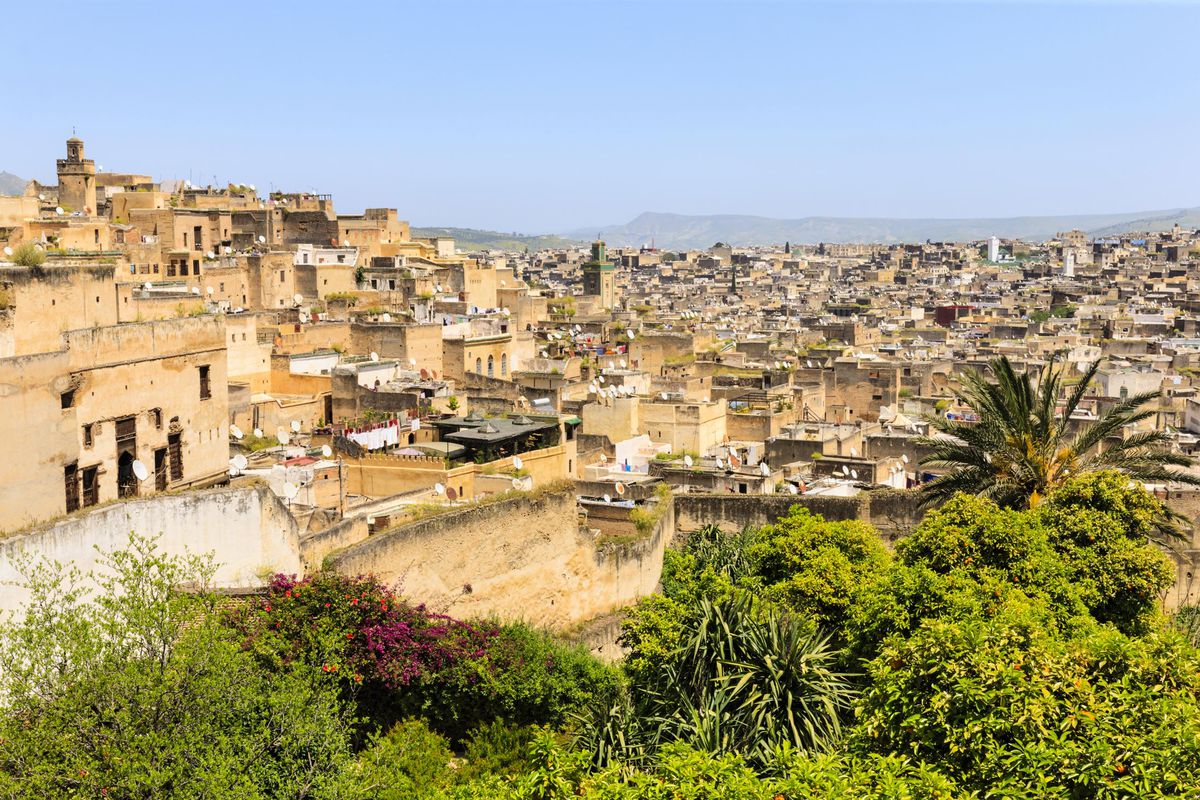
Today we did a walking tour of Fes El Bali, the extraordinary medieval walled city. Once inside the gates of this great spectacle, we saw an entirely different view of life in Morocco. In contrast to the well-planned Ville Nouvelle of Fes, the old city is a labyrinth of alleys and lanes lined with shops, mosques, homes and schools. In 1980 UNESCO designated the medina a World Heritage Site.


Lemons and olives


Our guide took us to the medina to view the market shops, or suks. Everything from food to clothing and handicrafts of all types are for sale and bargaining. We see the famous fabric dying area with the brightly coloured cloth hanging to dry and the leather tanning.


Leather Dying

We visit the Royal Palace, several mosques, theological schools, and shops where we can see craftsmen tailoring their work. We also walk through the jewish neighborhood. It is an amazing look into the life of the Moroccan city dweller where little has changed over the centuries.


Donkeys still bring in goods to Fes El Bali


Tuesday, May 7, 2019

Fes, Voli and Meknes


April 23 Fes, Voli and Meknes.

This morning we visit the impressive site of Volubilis, the best preserved Roman site in Morocco. Situated on the ledge of a long plateau, the dramatic site was once one of the Roman Empire's most remote outposts. Unfortunately it’s raining and cold, but the local guide gives us a very good tour of this impressive site. We do a photo stop due to the rain at the town of Moulay Idriss it is a dramatic sight, houses and mosques piled up around two rock outcrops.

Volubilis


We continue to Meknes, Morocco's youngest Imperial City first stopping at the Bab El Mansour gate dating from 1752, complete with its Corinthian columns. The city was built by a massive army of slaves, both Moroccan and Christian, and the Sultan was in particular famed for his barbaric treatment of these people, supposedly interring them in the walls. The city contained within it's walls all that was necessary for such a large population and military machine, with store houses, stables, armouries, exercise areas, gardens and ponds.


Bab El Mansour in Meknes

We are all cold and wet as we return to Fes. We stop at the equivalent of Walmart and stock up for the rest of our journey. We have a nice dinner at a local restaurant before returning to our riad and collapsing.


Heri es-Souani granaries in Meknes


Casablanca, Rabat and Fez.


April 22 Casablanca, Rabat and Fez. 

This morning we visit the Hassan II Mosque in Casablanca, a glorious structure believed to be only second in size to Islam's most important site, Mecca in Saudi Arabia. The mosque was inaugurated in August 1993, the culmination of five years of intensive labor by over 30,000 workers. We may only enter only as part of a guided tour.


Hassan II Mosque

From Casablanca we travel to Rabat, Morocco's third oldest Imperial City and modern capital. We visit the the Hassan Tower and the Mohammed V Mausoleum. Before leaving Rabat we have lunch at the Art Cafeteria which proves to be quite entertaining with all the confusion that our group generates.


Fes

We then travel to Fes arriving just in time for dinner. The historic city of Fes lies in the Oued Sebou basin, on the traditional trade route from the Sahara to the Mediterranean and the path.from Algeria and the Islamic heartland beyond. For centuries the dominant axis within Morocco was of Fes and Marrakech, two cities linked by their immense power and rivalry. Fes is still seen as the spiritual and cultural capital and holds an enduring fascination for visitors with one of the largest historic medinas full of monuments reflecting the different periods of Morocco's imperial past.

Add caption

Our riad is nestled at the end of a quiet street, near the heart of the ancient labyrinth of the medina of Fez, the Algilà Fès is comprised of three inter-connected 18th century residences, each an architectural gem in its own right, offering modern comforts in a traditional setting. It has 15 guest rooms around three separate courtyards fitted with fountains, palm trees and sitting areas. We have dinner in our riad which is quite good with a local flavor. Each riad has its own character as if you were visitings people’s homes. Some of our group would like more modern conveniences but we like the uniqueness.

Sitting area in Algilà Fès