Sunday, March 19, 2017

Vang Vieng

WED 15 MAR 2017

Hmong girl

Today we travel 7 hours by road to 245 kilometers to Vang Vieng, a small village nestled in a scenic bend in the Nam Song River and surrounded by breathtaking limestone scenery. This is rapidly becoming Laos's premier destination for eco-tourism. The outcrops have inspired many Lao legends and stories in Lao literature and are known as Phou Suan Mon Nang Eua, meaning Silk Tree Garden Mountains of the Princess. The area also contains an extensive network of caves some of which are outlets for underground streams.

Limestone cliffs on the Nam Song river

The road is mountainous and provides some amazing scenery.  We make several stops for breaks and photo opportunities one being a local Hmong village. The Hmong people generally come from the hill and mountain area just south of China. According to genetic evidence, Hmong people lived in China for 2000 years before generally migrating south in the 1700s. Here we meet a family that has just has a new baby and we see the local village school. 

Hmong family

We stop for lunch at a view road side restaurant however the air is thick with smoke from the annual burning of vegetation before the rains come. The latter part of our drive is truly spectacular limestone cliffs and sheer drops. About 20 kms before Vang Vieng, we'll stop at a bridge with a view of karsts. There's also an attractive wat immediately before the bridge that we stretch our legs and walk around.


After checking in at our hotel we take a swim in the pool and watch the sunset over the river and the mountains to our west.  We walk around town and get some dinner before retiring.


Saturday, March 18, 2017

The Mysterious Plain of Jars

TUE 14 MAR 2017 


Xieng KhouangIn has gone through many changes. In the 18th and at the beginning of the 19th century, it was the center of a kingdom of the Hmong (Meo). In 1832, it was conquered by the Vietnamese, annexing the entire region. The town of Xieng Khouang was totally destroyed during the Vietnam War. Even though it has been rebuilt in 1975, the name Xieng Khouang is now primarily used in reference to the province of the same name.


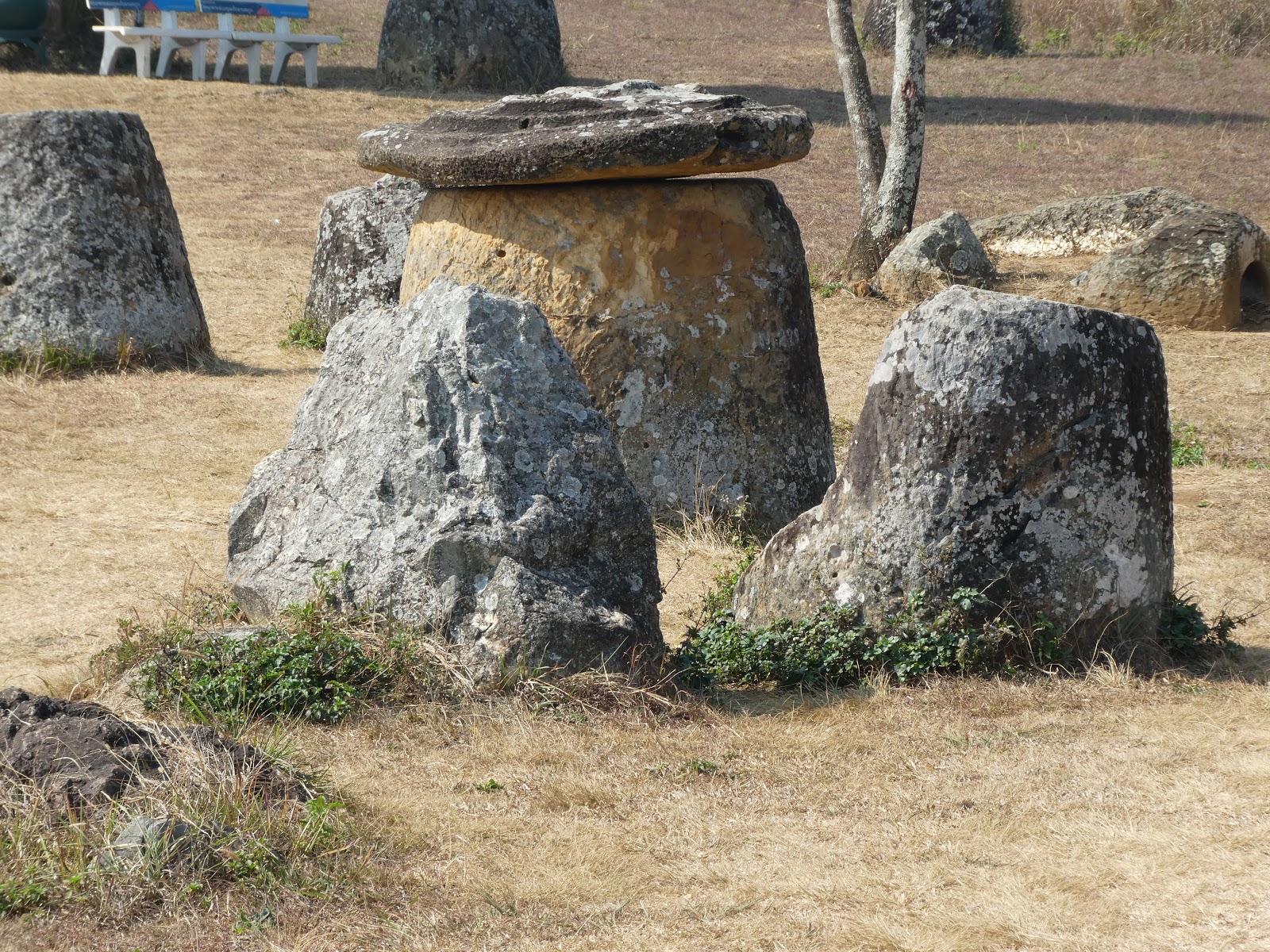
The highlight of our visit here is the Plain of Jars. Scattered over the area are hundreds of enormous limestone jars, each about 1 to 2.5 meters high, with a diameter of about 1 meter. There is still no explanation as to how the clay jars found their way onto the plain, nor what purpose they served.


 Archaeologists have come up with the wildest theories, among them a claim declaring them brewery cauldrons. More likely, the jars are enormous secondary burial urns. Many jars were destroyed or damaged during the Vietnam War, when the communist Pathet Lao his among the jars and built trenches to hid in.  There are caves they used for hiding as well. American planes bombed positions they thought the Pathet Lao were hiding in.

After the Plain of Jars visits we see how rice noodles are made and we visit the local market.  We take some time off to rest in the afternoon and then a break from local cuisine for some great Italian food with ice cream for desert, a nice change.


Thursday, March 16, 2017

On the bus to Phonsava

MON 13 MAR 2017 LUANG PRABANG - XIENG KHOUANG - PHONSAVAMON

Today we travel by road to Xieng Khouang about 240 kilometers at speeds ranging from 20 to 35 mph although the road the 13N is a main road it has many challenges.  It goes over mountains and through small villages. The pavement is fine in some locations, rough stone and dirt in others. We share the road with large trucks, busses, motorcycles, bicycles, animals and kids.  it takes us from 8:30 am to 4:30 pm with about 6 stops for local sites, bathroom breaks and lunch. 

Our lunch break is in Phou Khounat  the intersection of the 13N and the 7 road. After adjustment to the small town we have a simple lunch of noodles and vegetables. A cute dog wanders in and gets everyone's attention.  We stretch our legs walking through the town and going to an organic vegetable market.

Everyone is happy when we reach our hotel the Vansana. Our room is like a small suite with living room balcony as well as bedroom.  The hotel has character if not maintenance, like something in a David Lynch movie.


Then into the town of Phonsava and a drink at Craters Bar, a hole in the wall decorated with exploded ordinance from U.S. planes that seems appropriate for where we are.

Craters bar

We visit The Mines Advisory Group office and see a short film on the unexploded ordinance situation in Laos called "Bombies".  From 1964 to 1973, the U.S. dropped more than two million tons of ordnance on Laos during 580,000 bombing missions which is equal to equal to a planeload of bombs every 8 minutes, 24-hours a day, for 9 years. It made Laos the most heavily bombed country per capita in history. Over 20,000 people have been killed or injured by UXO in Laos since the bombing ceased. MAG Lao has located and destroyed 6,460 items of UXO, 3,257,638 square meters of land was cleared for agriculture, drainage canals, electricity pylons, water wells, school gardens, roads (to provide access to markets) in 2007and for a project to promote tourism at the historic Plain of Jars from January to June 2008, destroyed 3,537 items of UXO. Their work continues today.


Earlier in the day we visited a MAG site


After dinner our group leader, Pam, gets us the Loa version of a tuck tuck for the trip back to the hotel.

Tuck Tuck


Wednesday, March 15, 2017

Luang Prabang. Ancient Royal City

SUN 12 MAR 2017


In the 14th century, this city was established as the royal capital by Fa Ngoum, the first monarch of Lan Xang, the Land of a Million Elephants. By this time, the city had already been the seat of local kingdoms for 600 years. According to legend, the site of the town was chosen by two resident hermits and was originally known as Xieng Thong , Copper Tree City. Today this charming town, with its one main street lined with colonial era buildings housing shops and cafes.


We get up at 6 am to provide offering to monks that pass the hotel then a nice breakfast in the courtyard of our hotel. We then departure today takes to the Mekong River for a boat journey to visit the Pak Ou Caves. The boat is long and quite large, covered, with comfortable seat cushions, life jackets and even a WC.

Inside our boat
Inside cave


The Pak Ou Caves are two clefts in the side of a mountain stuffed with thousands of old Buddha images. The site has long been sacred for the Lao, even prior to Buddhism, when they worshipped spirits. The lower cave has over 4,000 images, ranging from 3 inches to 9 feet tall, stuck into nooks and crannies. The upper cave's Buddha images are placed far back into the cliff. There are  breathtaking view of the mountains, villages, and fishermen during the 2-hour boat ride.

Inside Pak Ou Caves


We return to Luang Prabang and visit the Royal Palace, a museum containing a collection of 15th-17th century Buddha statues including the significant Golden Buddha. The last member of the Lao royalty to live here was Sisavang Vong's son, Crown Prince Sisavang Vatthana.
We finish with a tour of the 16th-century Wat Xieng Thong with its richly decorated wooden interior. Wat Mai is another old temple of classic Luang Prabang design with gracefully curved roofs. We see many 400 year old wooden Buddha statues at Wat Wisunalat.

Leaving Myanmar. Arriving Laos.

SAT 11 MAR 2017


Today is mostly a travel day as we fly to Luang Prabang in Lao, a World Heritage Site. We leave the hotel at 6 am and fly to Bangkok to go through the customs and immigration to get our bags, then check in to our flight to Luang Prabang finally arriving about 4 pm.

Monks Praying at wat mai

So after spending 2 weeks in Myanmar it is still much a mysterious country. It has the resources in natural gas and precious gems to be a much richer country than it is, but years of corruption and neglect have left the infrastructure in bad condition.  The distribution of wealth is one of the worst in the world with most living on less than $2 per day and a few with great wealth.  Things are changing, tourism is doubling each year and with less than 500 thousand Americans visiting each year it has great potential.  Its tourist sites are beyond belief especially the Buddhist sites.

Wat mai

Well we finally get to the Lotus Villa Boutique Hotel our home for 2 days in beautiful Luang Prabang.  After settling in at this quiet wonderful 24 room hotel we walk to dinner for a Laotian sampler dinner.  Great food and we adjust to are much smaller group of 4 plus our tour leader.

Tasting menu at Tamarind Restaurant

Tuesday, March 14, 2017

Mount Kyaiktiyo - Bago - Yango

FRI 10 MAR 2017

Sun rise from the hotel. We are above the clouds.

We take the truck down the mountain to meet our bus and head back to Yangon. En route we stop to see a rubber farm and get an explanation of the process for harvesting the rubber. We head to the market for some shopping, then a walking tour of downtown that has the highest number of colonial period buildings in Southeast Asia and check out some street food.

This is where the rubber for your tires comes from/

Our last dinner in Myanmar with our traveling companions at the Skywalk restaurant with a view of the city. We walk around a roof top bar with music for the young and very cool.

Street food.

We are done for the day beginning to reflect on the time we have spent on the mysterious and hard to define land called Myanmar.  Only a few of us continue to Laos, 2 others and our tour leader, so we will be a very small tour through Laos.

Roof top view from the Skywalk restaurant


Sunday, March 12, 2017

Golden Rock

09 MAR 2017 YANGON - MOUNT KYAIKTIYO (GOLDEN ROCK)


Today we travel to Mount Kyaiktiyo, the third most important Buddhist pilgrimage site in Burma after the Shwedagon Pagoda and the Mahamuni Pagoda. A glimpse of the "gravity defying" Golden Rock is believed to be enough of an inspiration for any person to turn to Buddhism. Balancing on the cliff top at its peak, this huge boulder, covered in gold, is without doubt one of the most magical destinations in Myanmar.


The legend associated with the pagoda is that the Buddha, on one of his many visits, gave a strand of his hair to Taik Tha, a hermit. The Hermit, who had tucked it in the tuft of his hair safely, in turn gave the strand to the King, with the wish that the hair be enshrined in a boulder shaped like the hermit's head. Kyaiktiyo Pagoda has become a popular pilgrimage and attraction. At the peak of the pilgrimage season, an atmosphere of devotion is witnessed at Kyaikhtiyo pagoda.


To reach the rock we travel a winding 11km 45 minute ride  in an open truck with no top . Due to limited space, Our hotel for the night is the Mountain Top hotel which is on the peak and a 10 minute walk to the Golden Rock. A truly inspiring place that is worth the 6 hour trip. We are able to sleep with the windows open and hear the gentle chanting of the monks through out the night.